
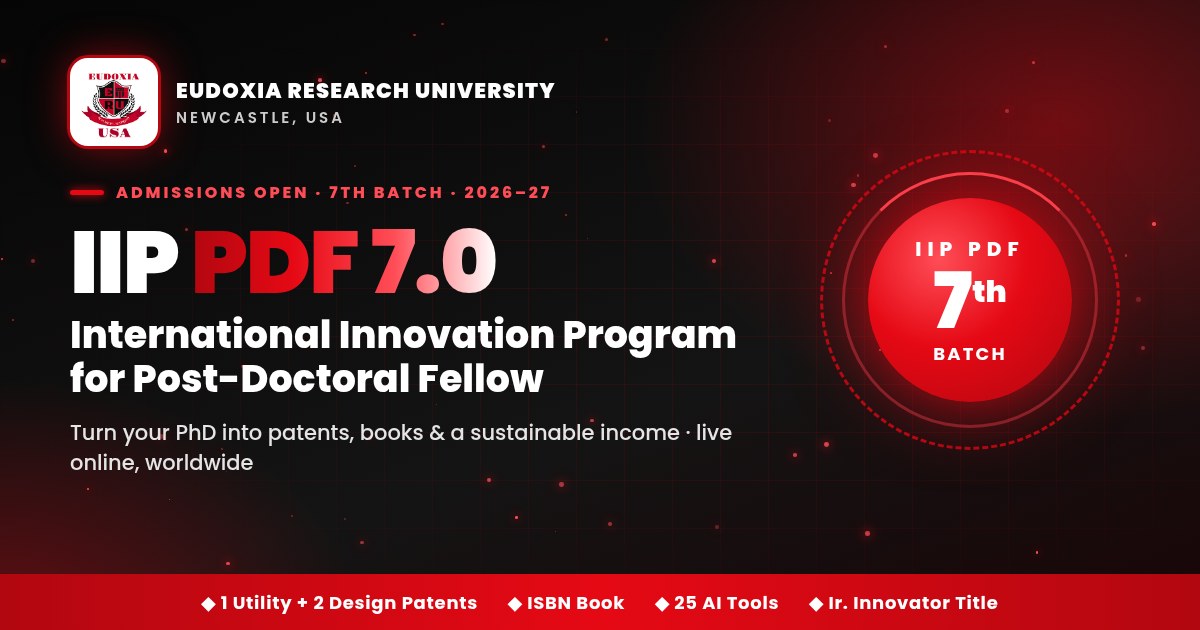
Admissions open · Seventh batch · 2026–27
IIP PDF 7.0 International Innovation Program for Post-Doctoral Fellow
A one- to three-year Research Executive Program in postdoctoral research, invention, and academic entrepreneurship.
Build a research portfolio through patent development, ISBN publishing, ethical AI, and live research software training.
Program outcomes
Turn postdoctoral research into work you can share
Develop and document research, practice with AI and software, produce patents and publications with mentor support, and explore career and income pathways.
Patent, copyright, and publication outcomes are subject to the review processes of the relevant offices and publishers.
Career and income development
Five ways to put research expertise to work
The program teaches practical routes to book royalties, expert speaking, funded projects, content creation, and leadership.
ISBN book royalties
Develop a thesis, research paper, or area of expertise into an ISBN book. The program lists 100% book royalty for registered scholars through Research Beacon Publication.
International webinars
Build the skills to deliver expert webinars in AI, methodology, data analysis, and industry topics. Practice presentation design and audience engagement.
Funded research projects
Learn to identify funders, write proposals, prepare budgets, and report outcomes. Funded projects can include salaries or stipends.
Academic and technical content
Develop research articles, books, institutional documentation, and technical content for academic and industry audiences.
Corporate and remote work
Learn digital marketing, SEO, academic branding, and digital workflows. Opportunities in the Eudoxia network depend on performance and organizational needs.
Curriculum
Master the process of invention
Six core units and five advanced modules cover research design, applied innovation, academic integrity, publication, and IP.
Identify innovation opportunities
Find research gaps and practical problems through structured analysis and interdisciplinary work.
Draft patents and protect IP
Learn the structure of patent documents and the steps for drafting and filing.
Turn research into intellectual assets
Develop patents, books, and technical outputs with academic or commercial potential.
Apply innovation in industry
Use case studies and mentor feedback to connect research ideas with real applications.
Apply AI and research software
Use tools to review literature, analyze data, and document methods and findings.
Follow a structured innovation workflow
Move from problem definition and ideation through development and IP protection.
Advanced modules A–E
A · Manuscript drafting and publication
Draft original and review articles, assess suitable journals, and explore no-fee publication routes in Scopus, Web of Science, IEEE, ABDC, and UGC-CARE contexts. Discuss h-, i-, and g-index measures.
B · Data collection, coding, and analysis
Compare manual and software-assisted methods for qualitative and quantitative research. Practice with NVivo, MAXQDA, and SPSS in live sessions.
C · Proposals, thesis, grants, and patents
Work through research proposals, grants, project submissions, dissertations, and patent preparation. The program guides one thesis toward an ISBN book and outlines the final certification process.
D · Research integrity and book publishing
Practice citation, originality checks, and ethical AI-assisted paraphrasing. Learn how to identify predatory and clone journals and prepare a book for publication.
E · Global careers and the digital campus
Explore international academic applications and D.Litt. or D.Sc. pathways. Practice reference management with Mendeley, Zotero, and EndNote, and plan professional courses for the International Digital Campus.
IIP PDF special classes
Learn AI Tools for Research, Data Analysis, and Interpretation
Practice with 25 tools in live demonstrations and research datasets. Choose a category to see what each tool helps you do.
Verify AI outputs against source material, follow disclosure requirements, and protect participant data.
Discover literature7 tools
Elicit.org
Find relevant studies and extract findings for a literature review.
Scite.ai
Examine the context in which later papers cite a study.
Connected Papers
Explore related papers through a visual citation network.
Semantic Scholar
Discover scholarly work and influential references.
Litmaps
Map related publications and follow changes in a literature base.
ResearchRabbit
Explore related authors, papers, and citation networks.
Perplexity AI
Find sources and cross-check answers against the cited material.
Read and synthesize5 tools
PDFgear
Read PDFs and extract points for review notes.
Scholarcy
Turn papers into structured summaries for initial screening.
Typeset.io
Prepare manuscript formatting for submission.
ExplainPaper
Clarify technical or difficult passages in research papers.
AI PDF (ai-pdf.com)
Query PDF contents and retrieve relevant passages.
Write and revise6 tools
ChatGPT (Free Tier)
Brainstorm research questions, outline drafts, and clarify concepts.
Scribbr AI Paraphraser
Revise phrasing while preserving meaning and attribution.
Grammarly (Free Plan)
Review writing for grammar, tone, and clarity.
Jenni AI
Draft and revise academic text with citation support.
Quillbot (Free Tier)
Paraphrase, summarize, and manage citations with care.
DeepL Translator
Translate abstracts and research passages for review.
Manage references2 tools
Paperpile (Free Tier)
Manage PDFs, citations, and a research library.
Zotero
Organize references and cite sources in Word or Google Docs.
Analyze data and text5 tools
Voyant Tools
Explore term frequency, co-occurrence, and patterns in text.
OpenRefine
Clean, standardize, and reshape inconsistent datasets.
KNIME Analytics
Build low-code analytics and machine-learning workflows.
Google Colab (Free)
Use hosted Python notebooks to analyze data and test models.
Orange Data Mining
Explore datasets and build visual machine-learning workflows.
Hands-on software training
Research Software under IIP PDF Program
Explore 18 platforms for statistics, data preparation, visualization, and qualitative research. Each entry shows a practical application.
Statistical computing5 platforms
- R
- Run statistical models and build reproducible plots.
- Python
- Work with Pandas, NumPy, SciPy, Matplotlib, Seaborn, and Plotly for modeling, automation, and visualization.
- JASP
- Run descriptive, Bayesian, regression, ANOVA, and psychometric analyses.
- jamovi
- Use an R-backed interface for correlations, effect sizes, and hypothesis testing.
- Tanagra
- Explore classification, clustering, and multivariate statistics.
Data mining and preparation3 platforms
- KNIME Analytics Platform
- Create repeatable analytics, preprocessing, and predictive workflows.
- Orange Data Mining
- Explore data, clustering, regression, and model evaluation visually.
- OpenRefine
- Clean, transform, and reorganize inconsistent datasets.
Dashboards and scientific visualization5 platforms
- Metabase
- Build SQL-backed charts, dashboards, and reports.
- Apache Superset
- Publish and explore interactive charts and dashboards.
- Tableau Public
- Build and publish interactive visualizations for research.
- Microsoft Power BI Desktop (Free)
- Create reports and dashboards in the desktop application.
- SPOT
- Visualize high-dimensional scientific and experimental datasets.
Qualitative and network analysis5 platforms
- QualCoder
- Code interviews, text, audio, and images for qualitative or mixed-methods studies.
- Taguette
- Code interview transcripts and documents for thematic analysis.
- OpenQDA
- Collaborate on qualitative coding and thematic analysis.
- ELAN
- Annotate audio and video for linguistic and observational studies.
- Gephi
- Analyze and visualize networks for bibliometrics and social research.
The program also lists training in SPSS, NVivo, MAXQDA, STATA, Jupyter, VS Code, and AI and agentic AI workflows.
Program benefits
Build a portfolio as a researcher and innovator
Lifetime Innovator (Ir.) recognition
Selected participants may receive invitations to Bharat TV or Eudoxia programs.
Utility patent
Mentored development and documentation for one utility patent.
UK and India design patents
Guidance for one UK and one Indian design patent.
ISBN book
Book publication with ISBN and originality checks.
Thesis-to-book support
Adapt a thesis or dissertation for publication.
Journal publication guidance
Orientation and mentoring on suitable journals and publication routes.
AI and GPT access
Research design, analysis, interpretation, and innovation ideation.
Research software access
Live training with tools including SPSS, NVivo, R, Python, and STATA.
Academic profile
World Best Academicians profile, biography, photograph, and e-certificates.
36 international conferences
Free entry and opportunities for research exchange.
843 live webinars
Free entry over the program.
Academia magazine
A profile publication opportunity.
International recognition
Opportunities to serve as a guest of honour.
EDX Talks
An opportunity to join the show as a guest.
Copyright
One copyright registration benefit.
Grants and IP support
Guidance on national or international grant proposals and filing processes.
Global research network
Connect with peers in a network spanning 193 countries.
Career advancement
Guidance for academic, research, and innovation roles.
Scholar journey
From application to certification
Apply
Submit your CV and publication list or teaching experience certificate.
Merit review
URC and DRC review prior research or teaching experience.
Register
Enrol under the merit-based or corporate-sponsored category.
Topic and proposal
Meet the Academic Senate and Research Council to refine an innovative topic.
Train with AI
Practice software, AI, patent drafting, and publication workflows.
Develop research outputs
Prepare patents, papers, and an ISBN book, and take part in conferences.
Publish the thesis as a book
Develop the thesis into an ISBN publication with guidance.
Certification and career development
Apply for final certification and explore royalty, webinar, project, and career pathways.
Foundation
Topic selection, pre-proposal review, research software, and academic branding.
Creation
Patents, ISBN publishing, grant proposals, and conference participation.
Income and leadership
Thesis-to-book publication, final certification, and pathways in webinars, content, and funded projects.
Eligibility
Who can apply to IIP PDF 7.0?
Ph.D. holders and thesis submitters
Completed a Ph.D. or submitted a Ph.D. thesis.
IIP alumni
Completed IIP with at least one peer-reviewed, no-fee Scopus-indexed paper.
Faculty members
At least five years of regular teaching at a college or university.
Corporate leaders
CEO, CMD, MD, CGM, COO, GM, CTO, or another senior role.
Special Entry scholars
Ghana, Nigeria, Bhutan, Bangladesh, Somalia, and Nepal.
Merit-based and corporate-sponsored routes are available. Selected scholars may complete the program in one year, with a special extension up to three years.
Admission and fees · 2026–27
Choose your registration option
A new batch opens each month. The admission deadline is the last day of the month, with a 5% early-bird discount for candidates admitted on or before the 20th.
Indian scholars
₹53,000One-time admission fee
Pay in INRInternational scholars
USD 710One-time admission fee
Pay in USDSpecial Entry Scheme
USD 700Ghana, Nigeria, Bhutan, Bangladesh, Somalia, and Nepal
Email before payingAdmission procedure
Submit a CV with your publication list or teaching certificate for merit review. After selection and registration, meet the Academic Senate and Research Council for topic selection and pre-proposal drafting. The program prioritizes innovative research with practical or societal value.
Academic leadership
Meet the university leadership

Prof. Dr. Rhituraj Saikia
President & CEO



IIP PDF 7.0 · Seventh batch
Speak with the admissions team
Get help with eligibility, registration, the Special Entry Scheme, or the program schedule.